

“Why should we hire you?” is not a casual question. It is a direct test of whether you can translate your experience into measurable business value under pressure.
In a remote or hybrid hiring process, this question carries more weight. Hiring managers are not only assessing your skills. They are assessing whether they can trust you to deliver results in a distributed team without constant supervision.
The strongest answer is not a confidence speech. It is a clear, structured value proposition that proves impact, aligns with the role, and shows how you will contribute from day one.
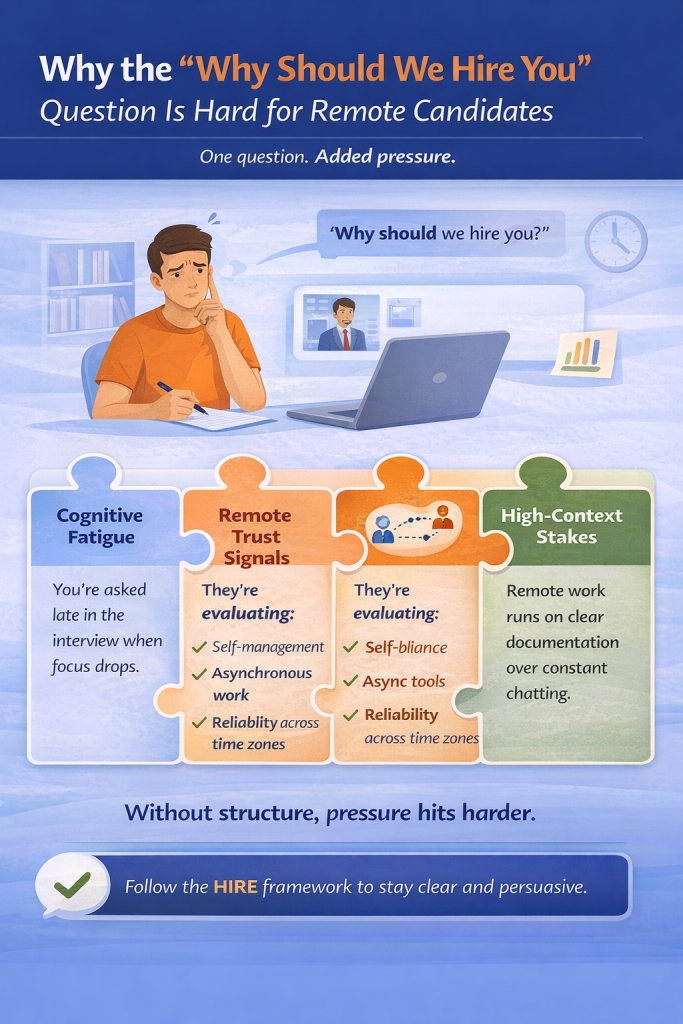
Why the “Why Should We Hire You” Question Is Hard for Remote Candidates
This question typically appears mid-interview when cognitive fatigue peaks. You have already explained your background, answered technical questions, and maintained focus on a virtual call. Now you must summarise your value in under 90 seconds.
Remote roles add another layer. Employers look for signals of:
- Self-management
- Asynchronous communication
- Reliability across time zones
Remote work operates in a high-context communication environment, where clear documentation replaces constant conversation. Candidates who rely on verbal clarification (low-context communication) often struggle in distributed teams.
If you feel pressure, that is normal. Performance improves when you use a repeatable structure instead of relying on confidence.
What the Interviewer Is Really Evaluating
This question measures strategic fit. The interviewer is scanning for three signals:
- Competence: Can you execute the role with sound judgment?
- Autonomy: Can you perform without constant supervision?
- Business value: Will your output justify the cost of hiring you?
Your goal is to connect your experience directly to their current bottlenecks, workflows, and targets.
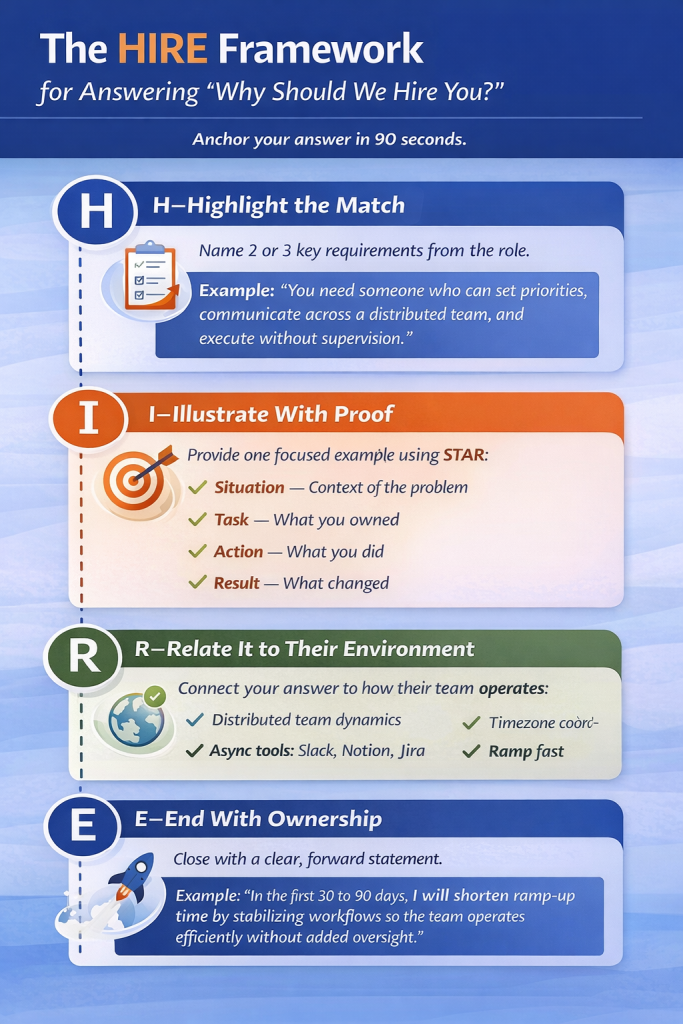
The HIRE Framework (A 90-Second Answer You Can Use for Any Role)
Use this structure to stay concise, relevant, and persuasive.
H — Highlight the Match
Start by identifying two or three requirements from the role.
Example:
“This role requires someone who can manage priorities, communicate across stakeholders, and improve workflows without slowing delivery.”
This shows you understand the job, not just your background.
I — Illustrate With Proof (Use STAR Once)
Prove your claim with one focused example.
Most companies use behavioral (competency-based) interviews, so past performance is the strongest signal of future performance.
Use a compressed structure:
- Situation
- Task
- Action
- Result
One strong example is enough.
R — Relate It to Their Environment (Where Most Candidates Fail)
Connect your experience to how their team actually operates.
Focus on:
- Distributed team dynamics
- Asynchronous communication (Slack, email, Notion)
- High-context documentation vs low-context communication
- Tools (CRM, Jira, Asana, Zoom)
- Time-zone coordination
- Bottlenecks mentioned in the interview
Example:
“This experience translates well to your distributed team because it improves async handoffs and reduces follow-up.”
Specific alignment is what separates strong candidates from generic ones.
E — End With Direction and Ownership
Close with a forward-looking statement that signals ownership and speed.
Example:
“In the first 30 to 90 days, I will shorten my ramp-up time by stabilising workflows, improving response times, and building documentation so the team can operate efficiently without added oversight.”
Clarity signals confidence. Specific outcomes signal value.
The Only 90-Second Template You Need
Use this structure every time:
- Highlight: “You need [Requirement 1] and [Requirement 2].”
- Illustrate: “In my last role, I [Action], which resulted in [Outcome].”
- Relate: “This aligns with your team because [Pain Point or Goal].”
- End: “In the first 30 to 90 days, I will [Plan], so you get [Outcome].”
Memorise the flow. Adapt the content.
Pro Tip: The 150-Word Rule (To Stay Under 90 Seconds)
A strong answer should be 120–150 words max.
- 120 words = ~60 seconds
- 150 words = ~75–90 seconds
If your answer is longer, you are explaining instead of positioning.
Rule: One story. One result. One clear outcome.
The Power Move: Data-Driven Proof (Even Without Metrics)
Hiring managers trust measurable outcomes. You do not need revenue numbers to demonstrate impact.
What Counts as a Metric
| Category | Example Impact | Remote Context (The How) |
|---|---|---|
| Efficiency | Reduced turnaround time | Improved async handoffs in Jira or Asana |
| Quality | Fewer errors or escalations | Documented processes to reduce Slack noise |
| Growth | Increased conversions | Optimised outreach and follow-ups |
| Customer Outcomes | Faster resolution | Managed time-zone coverage effectively |
| Organisation | Standardised workflows | Built a single source of truth in Notion |
| Cost/Time Saved | Reduced admin workload | Automated repetitive tasks |
If You Do Not Have Metrics, Use “Scope + Outcome”
Be specific about scale and change:
- “Handled 60 to 80 tickets daily while maintaining quality standards.”
- “Reduced reporting time from four hours to one hour.”
- “Built documentation that reduced repeat questions across the team.”
- “Standardised intake to prevent task duplication and delays.”
Specific language builds credibility quickly.
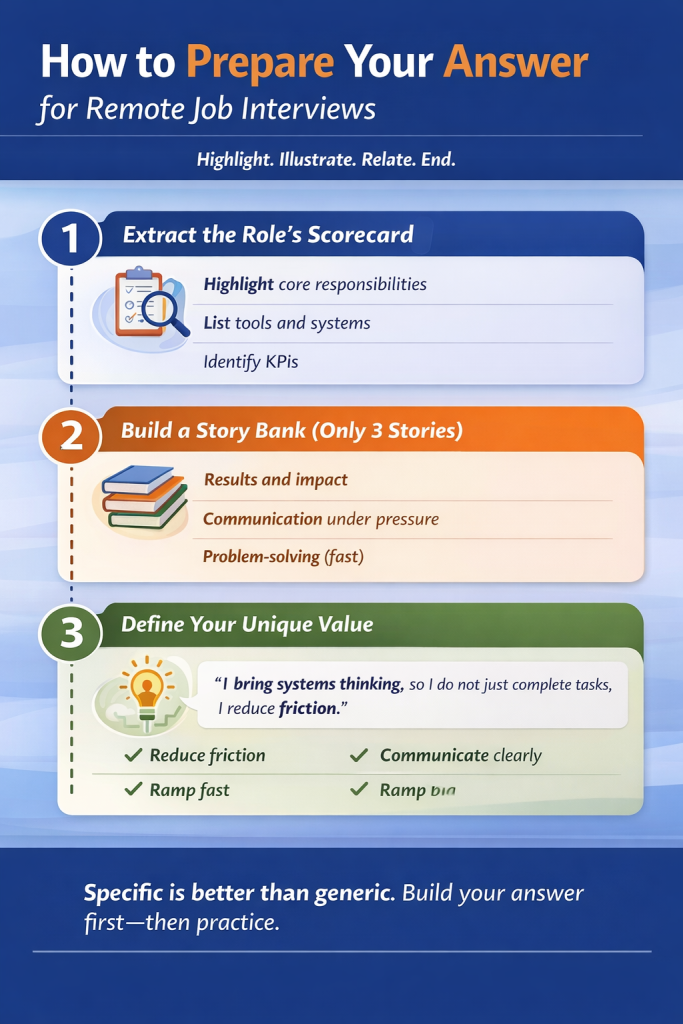
How to Prepare Your Answer (Fast)
Step 1: Extract the Role’s Scorecard
Identify:
- Responsibilities
- Tools
- KPIs
Convert these into outcomes. That becomes your Highlight.
Step 2: Build a Story Bank (Only 3 Stories)
Prepare examples for:
- Results
- Communication
- Problem-solving
This covers most interview questions.
Step 3: Define Your Unique Value
One sentence:
- “I improve systems so teams move faster without added complexity.”
- “I communicate clearly under pressure, which keeps distributed teams aligned.”
- “I ramp quickly because I document as I learn.”
Refined Sample Answers (90-Second Safe)
Customer Support
“You should hire me because you need someone who can resolve issues quickly while maintaining customer trust. In my last role, I managed a high-volume queue and improved tagging and documentation, which reduced repeat contacts and improved handoffs. This aligns with your distributed support team because strong documentation and async communication reduce delays. In the first 30 to 90 days, I will shorten my ramp-up time, master your knowledge base, and refine workflows so resolution becomes faster and more consistent.”
Sales
“You should hire me because you need someone who can build pipeline consistently and maintain a structured sales process. In my previous role, I improved follow-ups, tracked messaging performance, and maintained CRM accuracy, which increased booked meetings. This translates well to your remote environment where visibility and consistency drive results. In the first 60 days, I will shorten ramp-up time, refine outreach, and optimise based on performance data to improve conversion.”
Operations
“You should hire me because this role requires someone who can create clarity and protect priorities. In my last role, I built an intake system and centralised requests, which eliminated project drift and improved delivery speed. This is valuable for your distributed team because it creates a high-context system and reduces communication gaps. In the first 30 to 90 days, I will shorten ramp-up time, stabilise workflows, and create a single source of truth so execution becomes predictable.”
If You Freeze, Use This Recovery Line
“Great question. Let me take a second to give you a clear and structured answer.”
Pause. Then follow HIRE.
Common Mistakes That Weaken Your Answer
- Listing traits without proof
- Repeating your CV
- Overexplaining details
- Talking about what you want instead of business needs
- Using uncertain language
Clarity beats confidence.
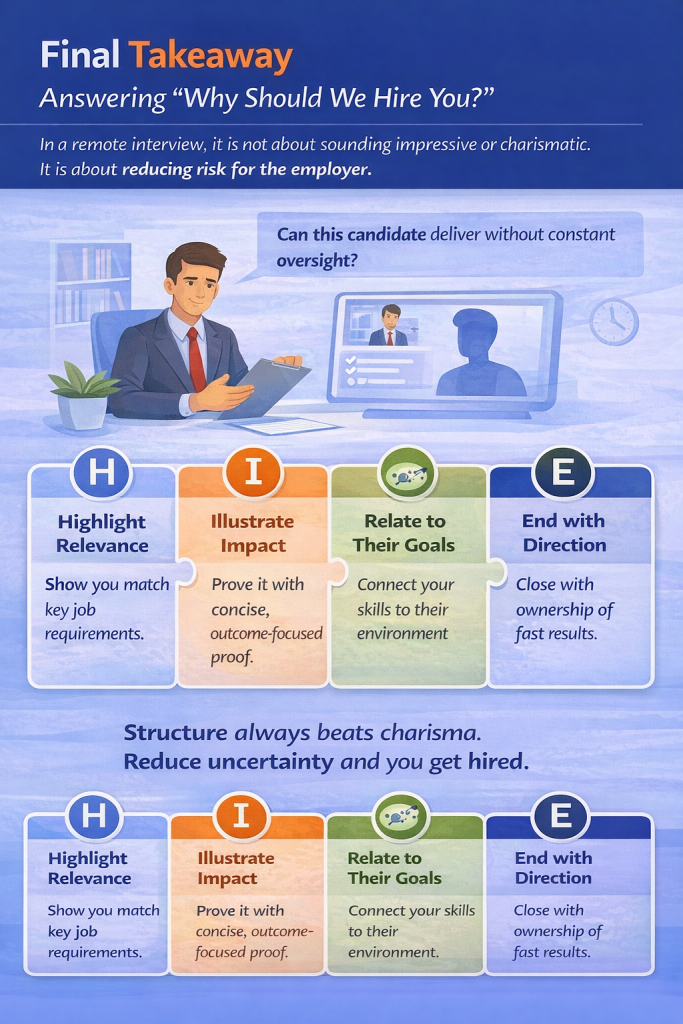
Final Takeaway
A strong answer is not about sounding impressive. It is about reducing risk for the employer.
- Highlight your relevance
- Illustrate your impact
- Relate to their environment
- End with direction
In remote hiring, the decision comes down to one question:
Can this person deliver without being managed?
Your answer should make that clear.


