

South African virtual assistant time zones for US clients create a structured advantage that goes beyond scheduling. The SAST–US offset enables businesses to compress execution cycles, extend operational hours, and maintain real-time coordination where it matters.
South Africa runs on South Africa Standard Time (UTC+2) with no daylight saving adjustments. The United States shifts twice annually, which creates a moving overlap window. That movement is not a minor detail—it directly affects meeting schedules, response times, and workflow timing.
Most companies treat time zones as a constraint. High-performing teams treat them as infrastructure for throughput.
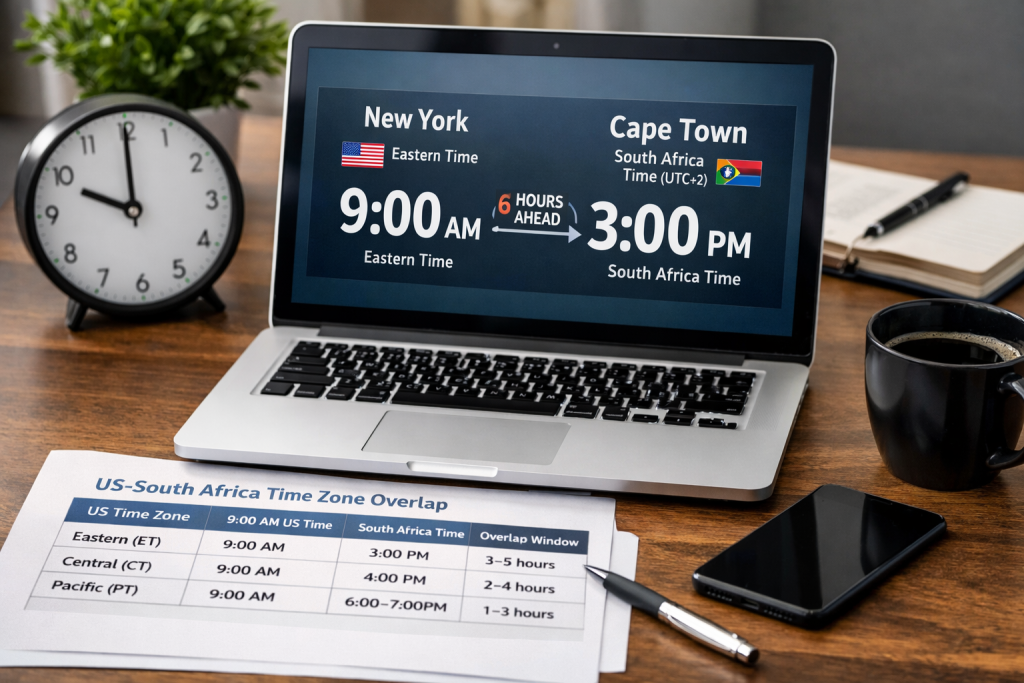
The Operational Math: Where the Overlap Actually Works
The alignment is consistent enough to build systems around:
| US Time Zone | 9:00 AM US Time | South Africa Time | Overlap Window |
|---|---|---|---|
| Eastern (ET) | 9:00 AM | 3:00 PM | 3–5 hours |
| Central (CT) | 9:00 AM | 4:00 PM | 2–4 hours |
| Pacific (PT) | 9:00 AM | 6:00–7:00 PM | 1–3 hours |
This creates a dual advantage:
- Synchronous window for decisions, meetings, and coordination
- Asynchronous window for execution and completion
A remote team benchmark analysis shows that 3+ hours of daily overlap is the threshold for maintaining decision velocity without meeting overload. South Africa consistently meets that threshold for US-facing work, particularly on the East Coast.
The Real Lever: The “Invisible Work Window”
The real advantage sits outside the overlap.
When US teams log off, South African VAs continue working—or begin structured execution. That eliminates idle time between task assignment and completion.
Example:
- 5:00 PM ET → Tasks assigned
- Evening SAST → Execution completed
- 9:00 AM ET → Results delivered
This reduces turnaround from 24 hours to roughly half a cycle, depending on task complexity.
In operational terms, this is cycle compression. Businesses that reduce task latency increase output without increasing headcount. Internal e-commerce benchmarks show that faster response and processing cycles can lift conversion and retention by double-digit percentages, particularly in support and sales workflows.

Why South Africa Works: Not Just Time, But Capability
Time zone alignment only matters if the execution quality holds. South Africa stands out because time, language, and infrastructure converge.
Language and Communication Precision
South Africa ranks in the high proficiency tier globally for English, with a strong emphasis on business communication. The practical difference shows up in:
- Clear written communication
- Neutral or globally familiar accents
- Low misinterpretation rates in client-facing roles
For US companies, this reduces rework. Poor communication remains one of the leading causes of operational inefficiency in distributed teams.
Cultural and System Alignment
South African professionals operate within Western business frameworks:
- Familiarity with US/UK clients
- Standard use of tools like Slack, HubSpot, Salesforce, Google Workspace
- Structured, deadline-driven workflows
This reduces onboarding friction. Teams integrate faster and require less supervision.
Established BPO Ecosystem
South Africa’s outsourcing sector is mature, not emerging.
Key hubs:
- Cape Town → Global BPO delivery centre
- Durban → High-volume support and operations
- Gauteng (Johannesburg/Pretoria) → Corporate and executive-level talent
The sector employs 270,000+ professionals and continues to grow due to international demand. This creates depth across roles—from entry-level support to specialized operations.

The Infrastructure Pivot: Why Connectivity Is a Competitive Advantage
The modern South African advantage is not just time alignment—it is enterprise-grade infrastructure.
Subsea cable systems such as:
- Equiano (Google-backed)
- 2Africa (Meta-led global network)
have significantly improved bandwidth, redundancy, and latency between Africa, Europe, and the United States.
The practical impact:
- Faster VOIP call quality
- Stable real-time CRM syncing
- Low-latency video conferencing
In many cases, connectivity between Durban or Cape Town and US East Coast servers now performs at levels comparable to nearshore regions.
This matters for roles that depend on:
- Live calls
- System access
- Continuous platform usage
Infrastructure is no longer a risk factor—it is part of the value proposition.
Risk Reality: Load Shedding and Professional Mitigation
Any credible guide must address load shedding directly.
South Africa experiences scheduled power outages. However, professional remote workers and agencies mitigate this through:
- Backup power (inverters, lithium battery systems, generators)
- Dual connectivity (fiber + LTE/5G failover)
- Co-working hubs with uninterrupted power
In the BPO sector, uptime expectations remain high. Many teams operate with near-continuous availability, even during grid instability.
The real differentiator is not whether load shedding exists—but whether the VA has redundancy systems in place.
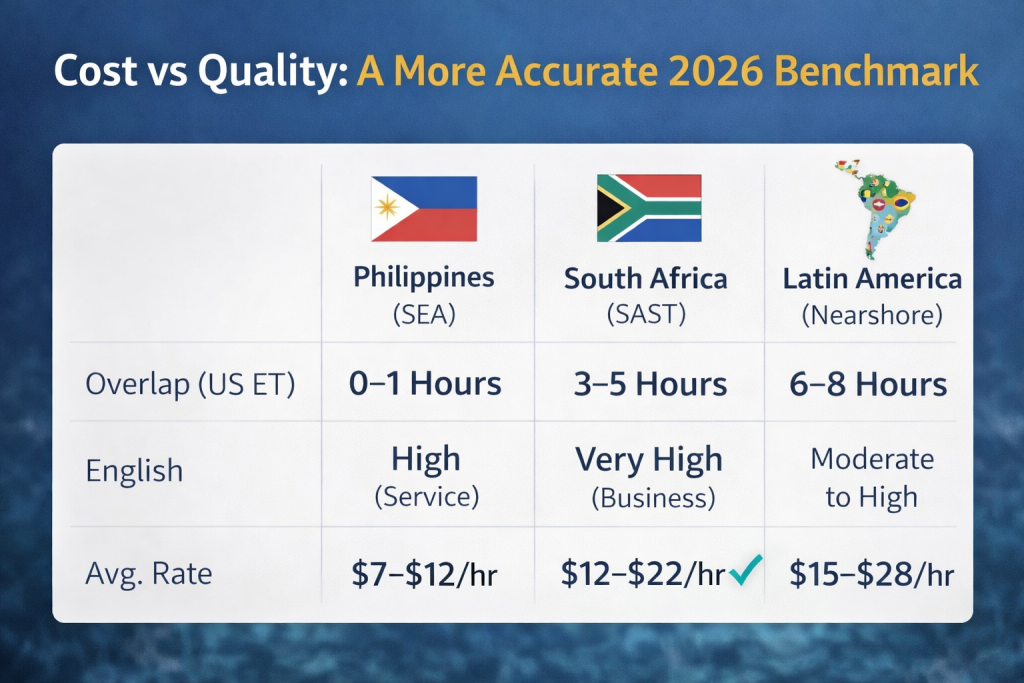
Cost vs Quality: A More Accurate 2026 Benchmark
Cost alone does not determine ROI—alignment and output do.
United States
- $45,000–$65,000/year
- Full alignment, highest cost
Philippines (SEA)
- $7–$12/hour
- Lowest cost
- Minimal real-time overlap with US
South Africa (SAST)
- $12–$22/hour (general roles)
- $28,000–$35,000/year (specialized roles: legal, operations, AI-enabled support)
- Strong overlap + high communication quality
Latin America (Nearshore)
- $15–$28/hour
- High overlap
- Variable English proficiency depending on region
South Africa occupies a middle position with a distinct edge:
- Better real-time coordination than Asia
- Lower cost than nearshore markets
- Higher communication clarity in many client-facing roles
For roles requiring responsiveness and accuracy, this balance often produces higher effective output per dollar, not just lower cost.
Where This Model Delivers the Highest Return
Executive Operations
Inbox, scheduling, and coordination tasks move into structured systems. Leaders reclaim time for decision-making and strategy.
Customer Experience
Response speed improves. Coverage extends beyond standard US hours. This directly impacts retention and satisfaction.
Sales and Pipeline Management
Lead follow-ups, CRM updates, and proposal tracking happen without delay. Faster engagement increases conversion probability.
Reporting and Back-End Operations
Daily reports, reconciliations, and system updates complete overnight. Teams start the day with current data.
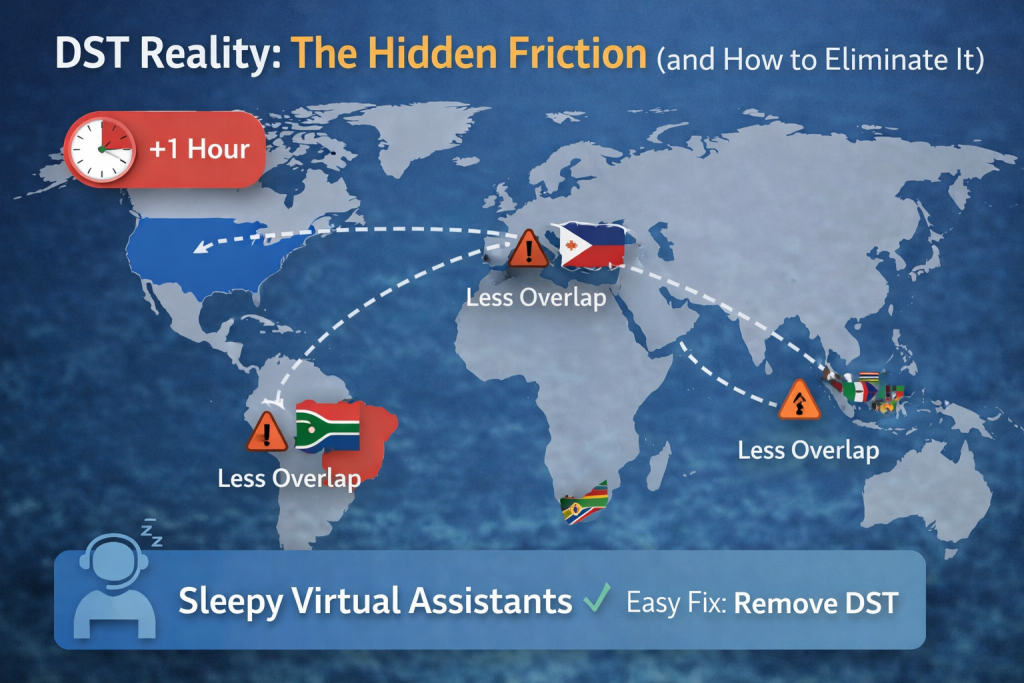
DST Reality: The Hidden Friction (and How to Eliminate It)
The US shifts clocks twice a year. South Africa does not.
This creates a 60-minute shift in overlap:
- March → overlap increases
- November → overlap decreases
This small change causes real issues:
- Missed meetings
- Incorrect calendar bookings
- Delayed communication windows
DST Survival Checklist
- Lock meeting times in one reference zone (ET recommended)
- Use tools that auto-adjust (Google Calendar, Outlook)
- Reconfirm recurring meetings during DST change weeks
- Communicate overlap hours explicitly after each shift
Teams that manage this proactively avoid one of the most common breakdowns in global operations.
How to Structure Work Around the Time Zone (What Actually Scales)
Define Overlap Windows
Example:
- 9:00 AM – 12:00 PM ET
- 3:00 PM – 6:00 PM SAST
Use this for decisions, not execution.
Split Work by Time Function
- Overlap → communication-heavy tasks
- Non-overlap → execution-heavy tasks
This prevents bottlenecks and meeting overload.
Build SOP-Driven Systems
Clear processes reduce dependency on live input. This is the difference between:
- Task assistants
- System operators
Use Asynchronous Tools Properly
- Slack → structured communication
- Notion / ClickUp → task tracking
- Loom → replace repetitive meetings
This reduces friction and increases execution speed.
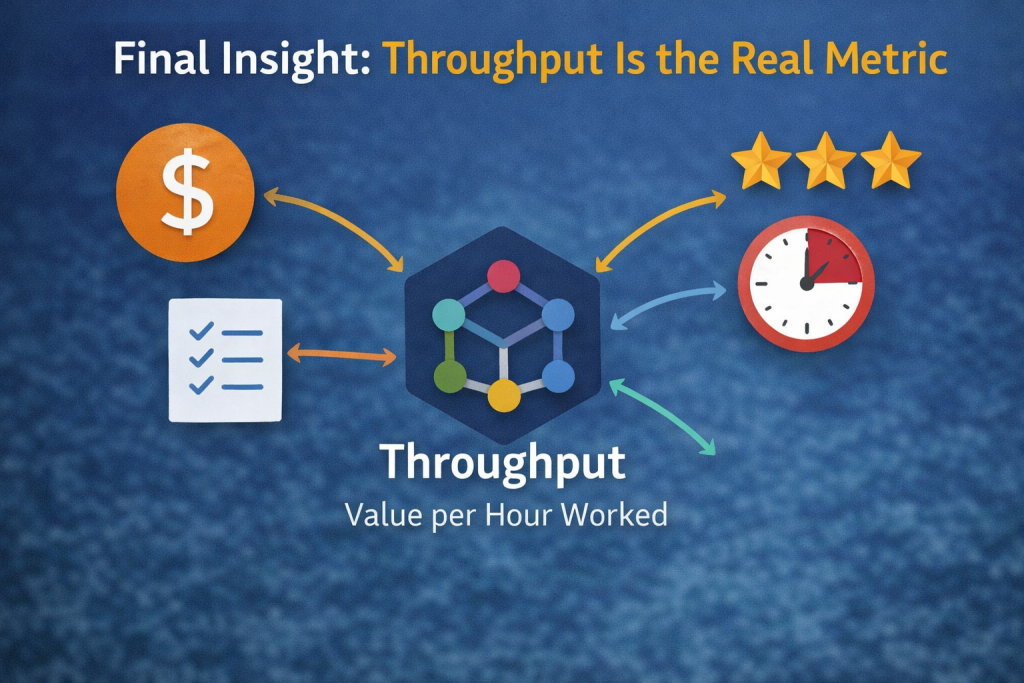
Final Insight: Throughput Is the Real Metric
Most companies compare remote talent on cost or availability. That misses the core variable: throughput.
South Africa enables:
- Real-time collaboration when needed
- Continuous execution when the US stops
- High communication accuracy
That combination increases speed of output per cycle, which directly impacts growth.
Time zones are not the story.
Throughput is.


