

Remote hiring is no longer experimental. It is a standard operating model for modern companies. US businesses increasingly build distributed teams to access specialized talent, control operational costs, and expand productivity beyond traditional office hours. Among global hiring destinations, South Africa has become one of the most attractive markets for administrative, operational, marketing, and technical support professionals.
Time zone alignment plays a central role in this shift. Many employers initially assume the distance between North America and Southern Africa will create coordination challenges. In reality, the time difference often produces a powerful operational advantage. With predictable overlap hours and structured workflows, US teams collaborate with remote professionals in South Africa effectively across industries.
This guide explains how the time zones align, why companies increasingly hire talent from South Africa, and how organizations structure remote support teams to maximize productivity.

Understanding South Africa’s Time Zone
South Africa operates on South Africa Standard Time (SAST), UTC+2. Unlike the United States and Europe, the country does not observe daylight saving time. This stability simplifies international scheduling because the time difference remains predictable year-round.
The United States spans four major time zones: Eastern, Central, Mountain, and Pacific. As a result, the working-hour gap varies depending on the location of the employer.
Typical Time Differences
| US Time Zone | Example City | Time Difference |
|---|---|---|
| Eastern | New York | 6–7 hours behind |
| Central | Chicago | 7–8 hours behind |
| Mountain | Denver | 8–9 hours behind |
| Pacific | Los Angeles | 9–10 hours behind |
When it is 15:00 in Johannesburg, it is 08:00 in New York and 05:00 in Los Angeles. This overlap means many remote professionals in South Africa begin work during the early morning hours of US businesses. Meetings, operational coordination, and client communication can happen in real time without requiring extreme overnight schedules.
Because the time difference is moderate, distributed teams usually maintain two to four hours of daily collaboration overlap, which research shows significantly improves remote team productivity.
Visualizing the Workday Overlap
The practical value of the time difference becomes clearer when viewed through a typical workday.
| South Africa (SAST) | Eastern Time (EST) | Business Activity |
|---|---|---|
| 14:00 | 07:00 | Planning and inbox management |
| 15:00 | 08:00 | Meetings and coordination |
| 16:00 | 09:00 | Operational tasks |
| 18:00 | 11:00 | Project execution |
| 20:00 | 13:00 | Reporting and documentation |
This schedule enables a hybrid workflow model. Real-time communication occurs during the overlap window, while deeper operational work continues independently.
Many companies describe this structure as a handoff productivity cycle, where tasks move across time zones instead of stopping when one office closes.

The Rise of South Africa as a Remote Talent Hub
South Africa has developed a reputation as one of the fastest-growing outsourcing destinations for Western companies. The country’s Business Process Outsourcing (BPO) industry has expanded rapidly over the past decade.
Industry reports estimate that the sector now employs over 300,000 professionals and continues to grow at double-digit rates. Major international companies operate service centers in cities like Cape Town, Johannesburg, and Durban. Cape Town’s technology ecosystem, often referred to as the Silicon Cape, has become a major hub for startups, software firms, and remote service providers.
Several factors drive this growth. The country produces thousands of university graduates annually in fields such as business administration, finance, and information technology. English is widely used in business and higher education, reducing communication friction for international teams. Reliable infrastructure and strong fiber-optic internet networks in major cities support remote collaboration.
These conditions allow distributed teams to operate with the same efficiency as traditional offices.
Talent Quality and Communication Standards
The quality of talent available in South Africa is a major reason international employers increasingly hire there. Professionals often bring strong educational backgrounds and familiarity with Western business practices. Many remote specialists previously worked in multinational corporations or global service firms before transitioning to distributed work.
English proficiency is another significant advantage. South Africa consistently ranks among the top non-Western countries for business-level English communication. This linguistic alignment allows remote assistants to handle customer support, scheduling, documentation, and client communication without language barriers.
Cultural familiarity also improves collaboration. South African professionals typically work within business frameworks similar to those used in the US and UK. Deadlines, structured workflows, and direct communication styles align closely with Western management practices.
In practical terms, this means distributed teams spend less time translating expectations and more time executing work.
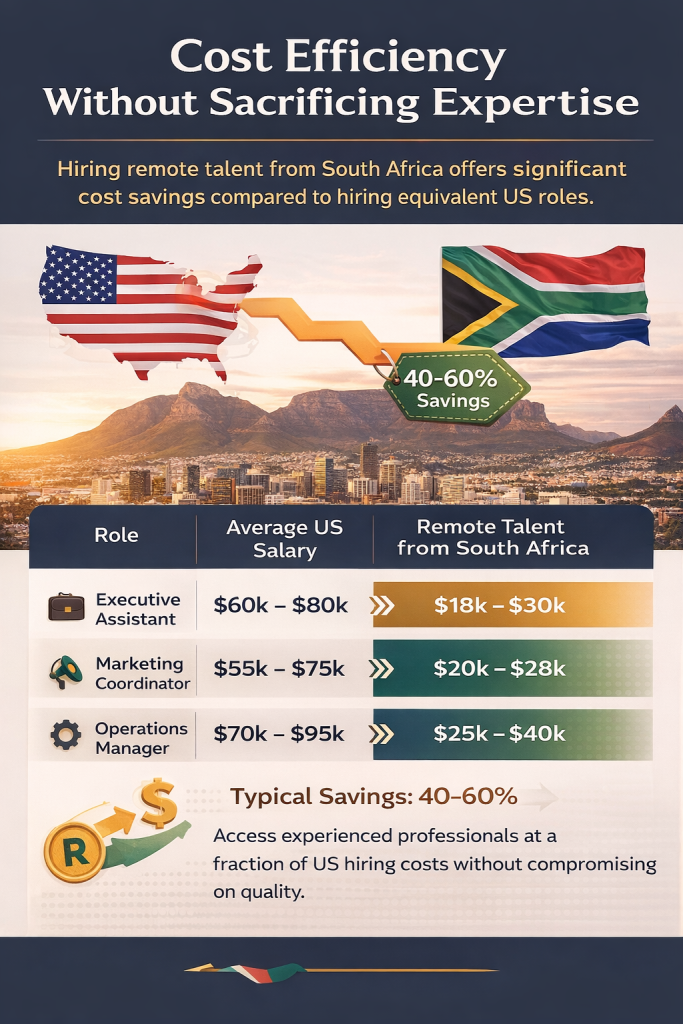
Cost Efficiency Without Sacrificing Expertise
Cost efficiency remains one of the most powerful incentives for hiring globally distributed support teams. Salary structures in South Africa allow companies to access experienced professionals at significantly lower cost than equivalent US hires.
Typical comparisons illustrate the difference.
| Role | Average US Salary | Remote Talent from South Africa |
|---|---|---|
| Executive Assistant | $60,000 – $80,000 | $18,000 – $30,000 |
| Marketing Coordinator | $55,000 – $75,000 | $20,000 – $28,000 |
| Operations Manager | $70,000 – $95,000 | $25,000 – $40,000 |
Companies frequently report 40–60% cost savings through international hiring. These savings do not come from reduced quality. Instead, they reflect differences in cost of living and local salary benchmarks.
For startups and small businesses, this labor arbitrage allows operational support to scale earlier in the company lifecycle.
The Follow-the-Sun Productivity Model
One overlooked advantage of distributed teams is the extension of the working day. When staff operate in different time zones, tasks move continuously rather than pausing overnight.
Consider a simple operational cycle.
A US team completes strategic planning during the afternoon. Tasks are then delegated to a remote operations specialist before the end of the day. Because the assistant begins work several hours later, the project progresses while the US team sleeps. By the next morning, documentation, research, or operational updates are already complete.
Technology companies often describe this workflow as the follow-the-sun model. Global consulting firms and technology companies have used this structure for decades.
In smaller organizations, remote assistants now provide the same capability.
Technology That Bridges the Time Zone Gap
Modern collaboration tools eliminate most coordination challenges associated with distributed teams. Remote professionals routinely use cloud platforms that enable real-time communication and asynchronous workflow management.
Common collaboration tools include:
• Slack for team communication
• Zoom for meetings and video calls
• Asana and ClickUp for project management
• Notion for documentation and knowledge bases
• Google Workspace for shared documents and calendars
Artificial intelligence tools increasingly support this workflow as well. Remote assistants often use platforms such as ChatGPT, Claude, and Perplexity AI to summarize research, draft communications, and automate repetitive tasks.
These technologies allow distributed teams to operate as cohesive units regardless of geographic distance.
Compliance, Payroll, and Legal Considerations
One question many employers ask is how to hire internationally while remaining compliant with local regulations. Several models allow companies to manage global payroll effectively.
A common approach is hiring independent contractors directly. In this structure, the professional operates as a freelancer and invoices the company monthly. Payment typically occurs through international transfer platforms such as Wise, Payoneer, or Deel.
Larger organizations often use an Employer of Record (EOR). An EOR service legally employs the worker in their home country while the company manages day-to-day work responsibilities. This arrangement simplifies tax compliance, payroll administration, and employment contracts.
South Africa also operates under POPIA (Protection of Personal Information Act), which regulates data privacy. POPIA functions similarly to the European GDPR, ensuring personal information is handled responsibly. Many international companies already work within these frameworks, making compliance straightforward.
For companies scaling distributed teams, these models remove most legal complexity from global hiring.
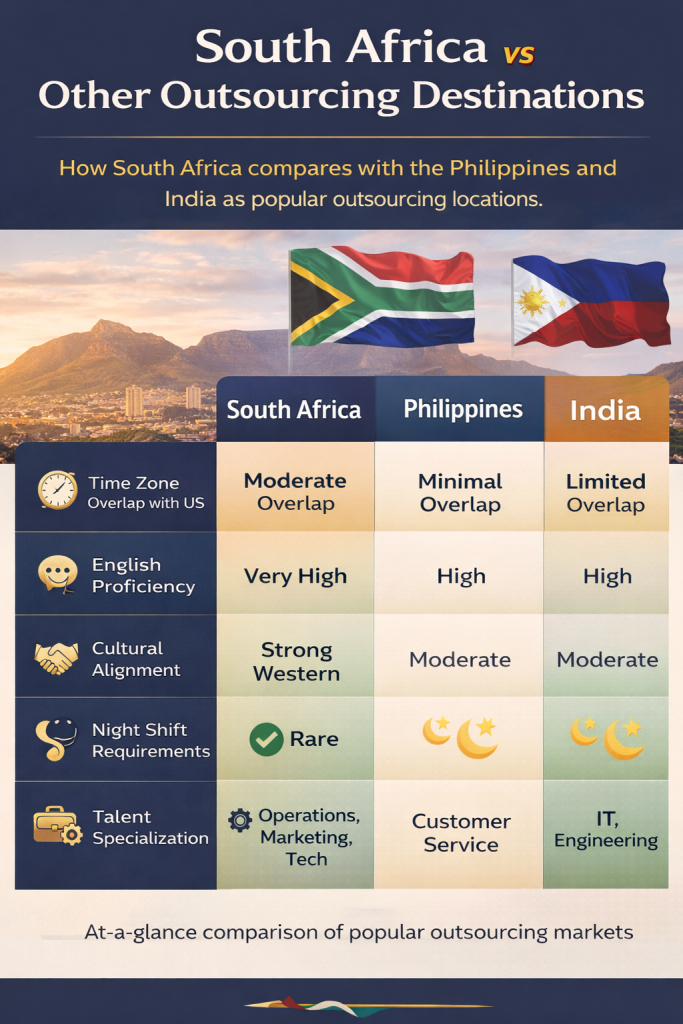
South Africa vs Other Outsourcing Destinations
Many businesses evaluating global hiring compare South Africa with traditional outsourcing hubs such as the Philippines or India. Each market offers unique advantages.
| Factor | South Africa | Philippines | India |
|---|---|---|---|
| Time zone overlap with US | Moderate overlap | Minimal overlap | Limited overlap |
| English proficiency | Very high | High | High |
| Cultural alignment | Strong Western alignment | Moderate | Moderate |
| Night shift requirement | Rare | Common | Common |
| Talent specialization | Operations, marketing, tech | Customer service | IT and engineering |
The Philippines remains a global leader in customer service outsourcing. India dominates software development and engineering outsourcing. South Africa increasingly fills the space between these markets by providing high-communication operational support roles.
For companies needing assistants, coordinators, and operational specialists, the balance of communication quality and time zone alignment often makes South Africa the preferred option.
How Distributed Teams Structure Remote Assistant Roles
Hiring remote support works best when responsibilities are clearly defined. Successful organizations divide responsibilities into operational layers.
Administrative coordination typically includes scheduling meetings, managing inboxes, and updating CRM systems. These tasks require responsiveness during collaboration hours.
Operational execution covers work such as documentation preparation, research, project tracking, and workflow management. Because these tasks do not require immediate communication, they continue asynchronously after the overlap window ends.
Strategic support roles include marketing coordination, lead qualification, onboarding workflows, and reporting. Experienced remote professionals often handle these responsibilities with minimal supervision.
This layered structure turns distributed assistants into operational partners rather than simple task managers.
The Future of Global Remote Work
The growth of distributed teams shows no signs of slowing. Analysts predict that over 90 million professionals could work remotely worldwide by 2030. Advances in communication technology, collaboration software, and AI automation continue to accelerate the shift.
Companies increasingly prioritize access to global talent rather than proximity to headquarters. Organizations that adapt quickly gain advantages in hiring flexibility, operational scalability, and cost control.
South Africa sits at a powerful intersection of these trends. Its time zone allows predictable collaboration with North American companies. Its workforce combines strong communication skills with competitive salary structures. Its technology infrastructure supports large-scale remote work.
These factors position the country as a long-term partner for distributed teams.
Final Thoughts
Hiring remote professionals across time zones once seemed complicated. Today it is a standard strategy for modern companies. When structured correctly, the time difference between South Africa and the United States becomes an operational advantage rather than an obstacle.
The predictable overlap between SAST and US time zones enables real-time collaboration during critical business hours. Modern technology bridges communication gaps, while distributed workflows extend productivity beyond the limits of a single office.
For companies seeking skilled operational support, global hiring opens opportunities that local recruiting cannot match. Among the available markets, South Africa stands out as one of the most balanced options.
The real question for employers is no longer whether the time zone works. The real question is how effectively the business designs its workflows to take advantage of it.


